
The xTool F series is the marking family. Five machines, four different light sources between them, and one thing that sets the whole family apart from every other xTool line: metal is the material it is mostly used on, not wood.
That is a beam question, not a wattage question. Two of these machines carry a 1064nm fiber source and one carries an ultraviolet source, and those are the wavelengths metal and glass actually absorb. This page covers what each of them marks, what it cuts, and where it stops.
Key Takeaways
- The F series marks metal, glass, stone, wood, leather, plastic and paper. Cutting is the exception here, not the rule.
- Bare stainless, brass and silver need a 1064nm fiber or MOPA source — the F1 Ultra and F2 Ultra. A diode alone will not mark them.
- Glass and crystal belong to the F2 Ultra UV. It is the only F machine that engraves inside a crystal block rather than frosting the face.
- These are small-bed marking machines. For cutting sheet goods thicker than a few millimetres, a CO2 machine is the right tool.
FYI: what are the xTool F-series machines?
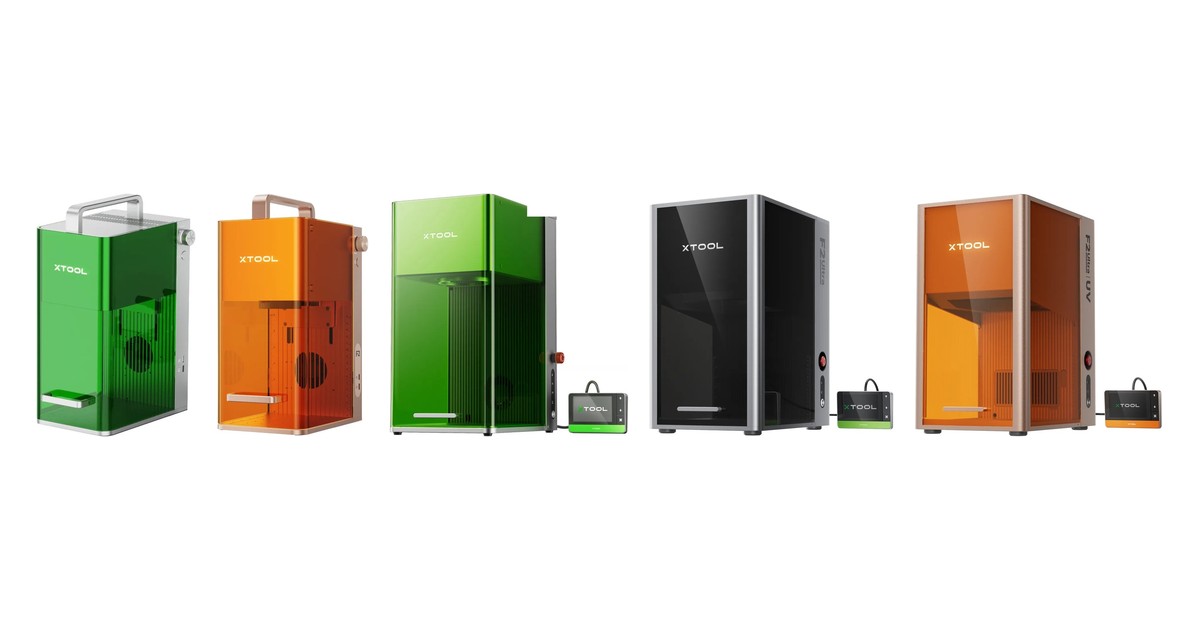
Short version, so the rest of this makes sense. All five are small, fast, enclosed marking machines. What separates them is the laser inside, and that is what decides the material list.
| Machine | Light source | Price |
|---|---|---|
| xTool F1 | 10W blue diode + 2W infrared | $819, refurbished only |
| xTool F2 | 15W blue diode + 5W infrared | From $1,499 |
| xTool F1 Ultra | 20W fiber + 20W blue diode | From $2,999 |
| xTool F2 Ultra | 60W MOPA fiber + 40W blue diode | From $4,299 |
| xTool F2 Ultra UV | 5W ultraviolet at 355nm | From $4,299 |
The F1 is sold out new and listed refurbished only. There is also an F1 Lite, which is a much smaller machine and not covered here.
For the machines themselves, read what the xTool F1 is and what the xTool F2 is. To compare across families, every xTool machine compared is the wider view.
What can you engrave and cut with an F-series machine?
Read the third column first. On this family the material does not just decide the settings — it decides which machine you need.
| Material | F1 | F2 | F1 Ultra | F2 Ultra | F2 Ultra UV |
|---|---|---|---|---|---|
| Bare stainless, brass, silver | Yes · engrave (2W infrared) | Yes · engrave (5W infrared) | Yes · engrave & emboss (20W fiber) | Yes · engrave, colour & cut thin sheet (60W MOPA) | Yes · engrave (5W UV) |
| Coated and anodized metal | Yes · engrave (10W or 2W IR) | Yes · engrave (15W or 5W IR) | Yes · engrave (20W or 20W fiber) | Yes · engrave (40W or 60W MOPA) | Yes · engrave (5W UV) |
| Wood, plywood and MDF | Yes · cut & engrave (10W) | Yes · cut & engrave (15W) | Yes · cut & engrave (20W) | Yes · cut & engrave (40W) | Yes · cut & engrave (5W UV) |
| Acrylic and two-tone sign plastic | Yes · cut & engrave (10W) | Yes · cut & engrave (15W) | Yes · cut & engrave (20W) | Yes · cut & engrave (40W) | Yes · cut & engrave (5W UV) |
| Leather and PU | Yes · cut & engrave (10W) | Yes · cut & engrave (15W) | Yes · cut & engrave (20W) | Yes · cut & engrave (40W) | Yes · cut & engrave (5W UV) |
| Paper and card | Yes · cut & engrave (10W) | Yes · cut & engrave (15W) | Yes · cut & engrave (20W) | Yes · cut & engrave (40W) | Yes · cut & engrave (5W UV) |
| Stone, slate and ceramic tile | Yes · engrave (10W) | Yes · engrave (15W) | Yes · engrave & emboss (20W fiber) | Yes · engrave (40W or 60W MOPA) | Yes · engrave (5W UV) |
| Glass, surface frost | Yes · engrave (10W) | Yes · engrave (15W) | Yes · engrave (20W) | Yes · engrave (40W) | Yes · engrave (5W UV) |
| Glass and crystal, inside the block | No | No | No | No | Yes · 3D inner engraving (5W UV) |
| Fabric | Yes · engrave (10W) | Yes · engrave (15W) | Yes · engrave (20W) | Yes · engrave (40W) | Yes · engrave (5W UV) |
Every material links to its own section below. The wattages are each machine’s own laser heads. Cutting on these small beds means thin stock only. Fabric, bare metal on a diode-only machine and PVC are covered in what the F series is not for.
The light source decides the material
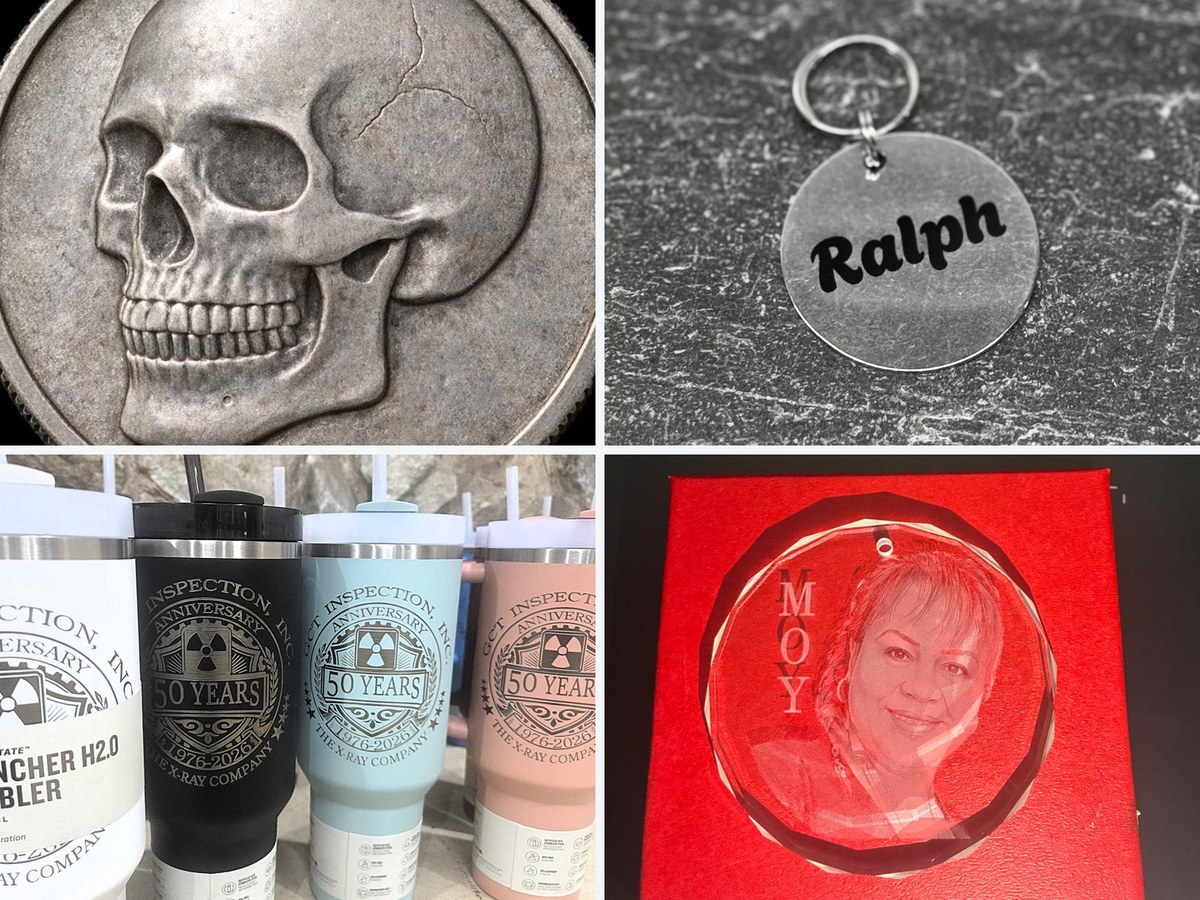
Four beams, four jobs: fiber on brass, MOPA on stainless, blue diode on coated drinkware, ultraviolet inside crystal.
A blue diode beam is absorbed by dark, organic surfaces — wood, leather, cardstock, dark acrylic. Bare metal reflects it, so no amount of diode wattage will mark bare stainless.
Infrared and MOPA fiber run at 1064nm, and metal absorbs that. A fiber laser anneals or ablates the surface, so the mark sits in the metal rather than on it. MOPA adds an adjustable pulse, which is what produces colour on steel.
Ultraviolet at 355nm is absorbed by almost everything, clear glass included, and it works cold. Nothing scorches, edges do not brown, and the beam can be focused inside a transparent block. That is the case for a UV laser engraver.
Metal: the family speciality
Metal is the biggest material group on the F series, which is true of no other xTool family. The reason is simply that three of the five machines carry a source metal absorbs.
Bare stainless, brass and silver

A stainless keyring bar engraved with GPS coordinates.
Small infrared heads reach bare metal, but slowly. A 20W fiber does the same job in one pass.
More metal our makers have tested
Bare metal needs 1064nm, and that means the fiber side: a rock coaster embosses at 3800 mm/s and 100% on the F1 Ultra’s 20W fiber, and a 0.2mm alumina sheet engraves at 80 mm/s and 90% on the F2 Ultra’s 60W MOPA.
MOPA is the classic colour tool and the only one that cuts thin brass and stainless outright. Colour marking itself also shows up on the F2 and the UV machine, so it is not exclusive to MOPA — the 60W head is simply the one built for it.
Coated and anodized metal
Coatings are far easier, and every machine in the family manages them: a pink-to-silver tumbler at 35 mm/s and 35% on the F2’s 15W diode, a green anodized pendant at 1800 mm/s and 70% on the F1 Ultra’s diode.
For blanks worth buying, the metal material page separates bare from coated, and the jewelry blanks page covers rings, tags and pendants. The metal machine comparison puts these against other brands.
Glass and crystal: the UV machine’s territory
Every laser can frost the outside of a glass. Only an ultraviolet source can focus inside a solid block and leave the surface untouched, which is why the F2 Ultra UV is the only machine here that does 3D crystal work.

A dog portrait engraved inside a K9 crystal block.
The surface stays perfectly smooth. A cold beam focused below it does all the work.
More glass our makers have tested
Surface work is available on any of them: tinted glass engraves at 400 mm/s and 80% on the F1 Ultra’s diode, a soda-lime cup at 150 mm/s and 70% on the F2 Ultra’s 40W diode. Curved glassware needs a rotary to hold focus.
UV also handles small, awkward glass: glass cabochons at 200 mm/s and 100%. The glass and crystal page lists K9 and K5 blanks with tested settings, and the UV comparison covers the category.
Wood, plywood and MDF
Wood is the second family here, and it is an engraving material on these machines rather than a cutting one. The beds are small and the diodes are modest, so deep cutting is the wrong job to bring them.

Lettering engraved along a bamboo pen.
Small cylindrical wood is exactly what these beds suit, and it needs a rotary rather than more power.
More wood our makers have tested
Engraving runs fast: 6mm basswood plywood at 200 mm/s and 100% on the F2, and the bamboo pen above at 300 mm/s and 70% on the F2 Ultra. The UV machine engraves wood too — 6mm pine plywood at 500 mm/s and 100% — with no scorch ring at all.
Species and grade matter more than wattage for finish. The wood material page lists boards with tested settings, and the wood machine comparison covers heavier cutting options.
Plastic and two-tone sign stock
Two-tone laser plastic — the engraving stock signmakers use — is one of the most reliable materials on this family. The beam lifts the top colour to reveal the core, and every light source here does it.

Two-tone plastic tags engraved with the number 123.
The beam lifts the yellow surface layer to expose the black core underneath. No ink involved.
More plastics our makers have tested
The same family of stock works on every beam: black-to-white sheet at 80 mm/s and 35% on the F2’s infrared, and black-to-white again at 400 mm/s and 80% on ultraviolet.
Cutting plastic is possible but slow: one 1.3mm sheet took 200 mm/s at 45% over 25 passes on a 40W diode. That is a marking machine being asked to cut, and it shows.
Avoid polycarbonate and anything unidentified. The acrylic material page covers which grades behave.
Stone, slate and ceramic tile
Hard mineral surfaces engrave well and cut not at all. They also take high power comfortably, which makes slate a good first test material on any of these machines.

A speed-and-power test grid on rock slate.
Slate is flat, cheap and forgiving, which makes it the standard first test on any of these machines.
More stone our makers have tested
The same blank runs on the F2 at 400 mm/s and 60%, and on the F2 Ultra UV at 200 mm/s and 100% on ultraviolet. The fiber side works too — a black slate plaque at 1000 mm/s and 70% over three passes.
Painting the engraved area and wiping it back fills the mark for more contrast, which is standard practice on slate coasters.
Leather and PU
Leather wants speed and a light touch on any beam here. Too much power and you get a burnt halo instead of the clean debossed line you were after.

A stack of round laserable PU patches engraved with logos.
Patch work is one of the most common F-series jobs, and it wants high speed at low power.
More leather our makers have tested
Brown-to-gold stock engraves at 80 mm/s and 60% on the F2 Ultra’s 40W diode. Ultraviolet gives the crispest line on natural grain — 2mm top grain cowhide at 80 mm/s and 48%.
Cutting hide is possible on the 40W diode but slow, and thickness varies across a single skin. The leather material page covers which hides behave.
Paper and card
Paper is thin, fast work on these machines, and the risk is scorching rather than failing to mark.
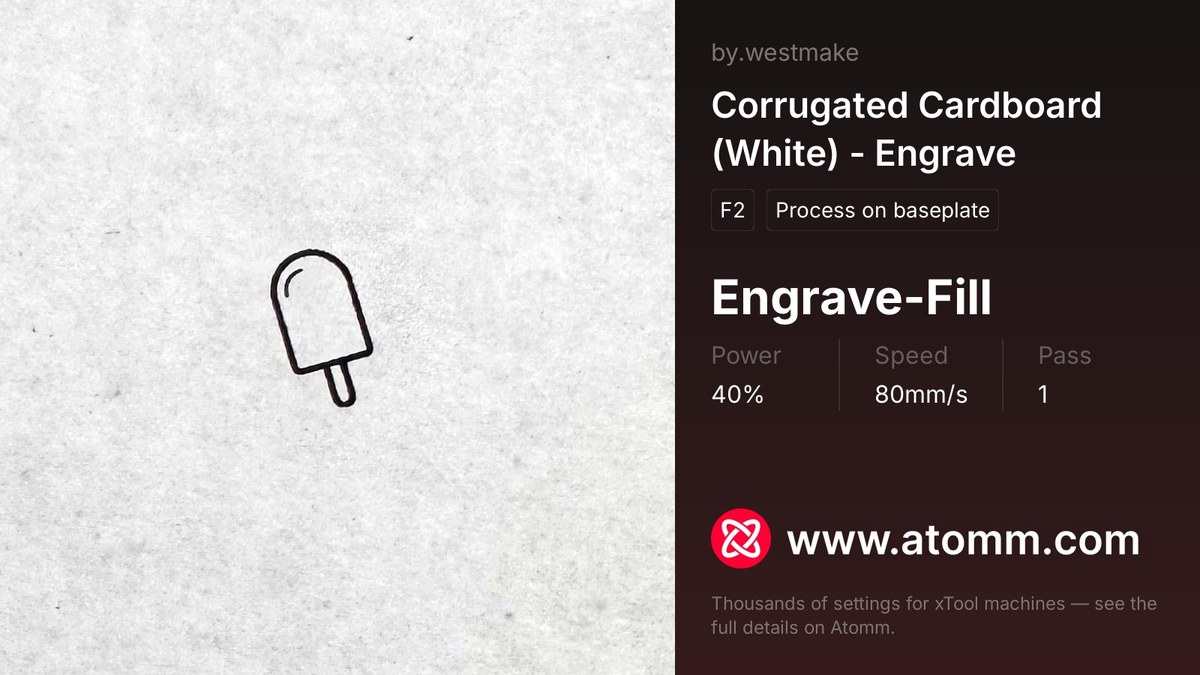
A small ice-cream shape engraved into white corrugated cardboard.
Paper is thin, fast work here. The risk is scorching the sheet rather than failing to mark it.
More paper our makers have tested
Photo paper engraves at 80 mm/s and 50% on the F1 Ultra, and shimmer paper took four passes at 80 mm/s and 100% on ultraviolet. Cutting card works — white cardstock at 15 mm/s and 29% over three passes — but a craft cutter does it better.
The paper material page has stock with tested settings.
What the F series is not for
Cutting sheet goods
All five cut thin stock, and the UV machine cuts thin wood, paper and leather too. What none of them does is production cutting: the beds are small, and one 1.3mm plastic cut in the tested set needed 25 passes. For sheet goods a CO2 machine is the right tool and it is not close.
Fabric
Technically fine, practically pointless. The working area is too small for garment work, so fabric barely features on this family at all — a diode marks cloth well, but not here.
PVC and unidentified vinyl
Never, on any machine. The chlorine released corrodes the optics and rails and is dangerous to breathe. If a sheet is not clearly labelled, do not run it.
Bare metal on a diode-only machine
The F1 and F2 carry small infrared modules, which handle coated stock and some plastics. Bare stainless and brass want the F1 Ultra’s 20W fiber or the F2 Ultra’s 60W MOPA.
Which F-series machine should you buy?
Work backwards from the material, because on this family the material really does pick the machine.

The F2 Ultra UV is the only F machine that engraves inside crystal, and the only one that marks without heat.
For wood, leather, coated metal and slate, the F2 at $1,499 covers all of it and is the value pick. For bare metal, the F1 Ultra at $2,999 is the entry point.
For colour on stainless and cutting thin brass, only the F2 Ultra does it. For glass, crystal and burn-free detail, only the F2 Ultra UV. And the F1 at $819 refurbished is still a capable small marker if the budget is the constraint.
Final thoughts
The F series is the only xTool family where metal, not wood, is the main material. That comes from the light sources rather than the wattage, and it is why the five machines are not one machine at five prices.
Pick the beam that matches the material you actually work in, keep the cutting jobs for a bigger machine, and start from a setting that has already been tested on your exact head.
What materials can the xTool F series engrave?
Bare and coated metal, glass and crystal, wood, plywood and MDF, acrylic and two-tone sign plastic, stone, slate and ceramic tile, leather and PU, and paper. Metal is the family speciality because three of the five machines carry a 1064nm or ultraviolet source.
Which xTool F machine engraves bare stainless steel?
The F1 Ultra, with its 20W fiber laser, or the F2 Ultra with its 60W MOPA. The F1 and F2 carry small infrared modules that handle coated metal and some plastics, but bare stainless and brass want the bigger fiber sources.
Can an F-series machine cut wood or acrylic?
Thin stock only, and slowly. One 1.3mm plastic cut needed 25 passes on a 40W diode. These are marking machines with small beds; for cutting sheet goods a CO2 machine is the right tool.
Do I need the UV model for glass?
For frosting the outside face, no — any of them will do it, and tinted glass engraves at 400 mm/s and 80% on the F1 Ultra. For engraving inside a K9 or K5 crystal block without touching the surface, the F2 Ultra UV is the only option.
What does MOPA add over a normal fiber laser?
An adjustable pulse duration, which is what produces colour on stainless steel and lets the beam cut thin brass and steel outright. Only the F2 Ultra has it; the F1 Ultra’s 20W fiber marks metal but does not colour it.
Is the xTool F1 still worth buying?
As a refurbished unit at $819 it is a capable small marker — a 10W diode with a 2W infrared module, so wood, leather, cardstock and coated metal are all in range. It is sold out new, but nothing about that changes what it can do.
Got the material? Get the settings.
Every material on this page has tested power, speed and pass numbers behind it. Browse the full material library, or filter it down to your own machine.
