
At $2,999.00 both of these sell a machine pairing a fiber source with a diode. On paper they nearly coincide. In use they are different classes of tool, and the difference is not power.
One goes to the work. The other makes the work come to it. Everything else follows from that.

Design something to engraveFree generators that export ready artwork for any laser, portable or bench.Explore generatorsKey Takeaways
- LaserPecker sells portable tools; xTool sells bench tools.
- Portable wins when the object cannot fit on a bed or cannot be moved.
- Bench wins on work area, batch runs and cutting sheet stock.
What Class of Tool Each One Is
This is the whole comparison, and it is worth being concrete about what it means day to day.
Portable
A LaserPecker sets up on whatever flat surface is available and works on the object in front of it. The LP1 Pro is listed at $279.00 and 600 grams — it goes in a bag.
The consequence is that your work area is whatever the head can reach, not a bed you bought. For a guitar body, a door, a finished cabinet or a market stall, that is exactly right.
Bench
An xTool lives in one place with a defined bed — the S1 publishes 2393 x 15.16 in. — and an enclosure around it.
The consequence is that everything has to come to the machine and fit inside it, in exchange for repeatable positioning and a work area you can plan around.

Where the Ranges Actually Overlap
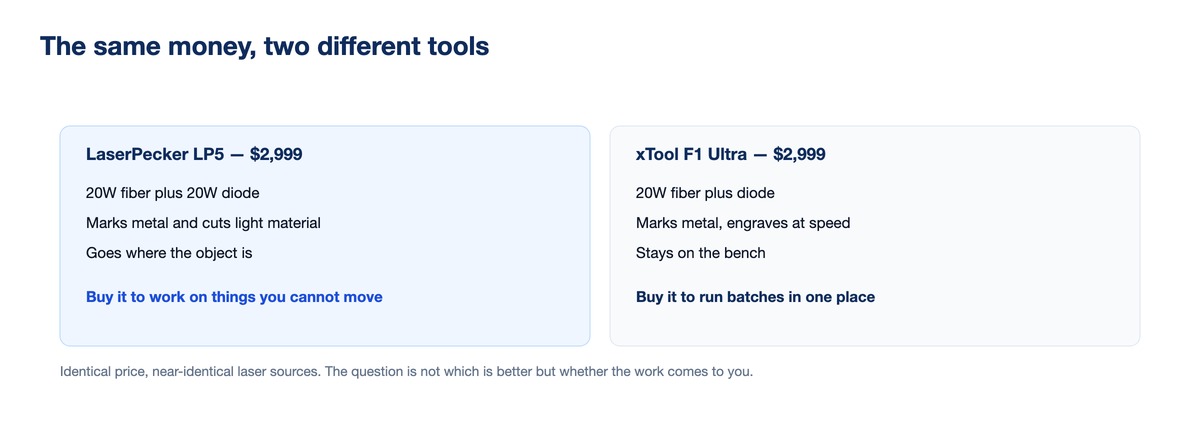
The clearest way to see the difference is at the point where price and specification stop separating them.
LaserPecker LP5, $2,999.00:
20W fiber plus 20W diode, up to 10,000 mm/s.
xTool F1 Ultra, $2,999.00:
a 20W fiber paired with a diode, on a bench.
Both mark bare metal. Both engrave quickly. Choosing between them is not a specification argument at all — it is a question about whether the thing you are engraving will fit in a box.
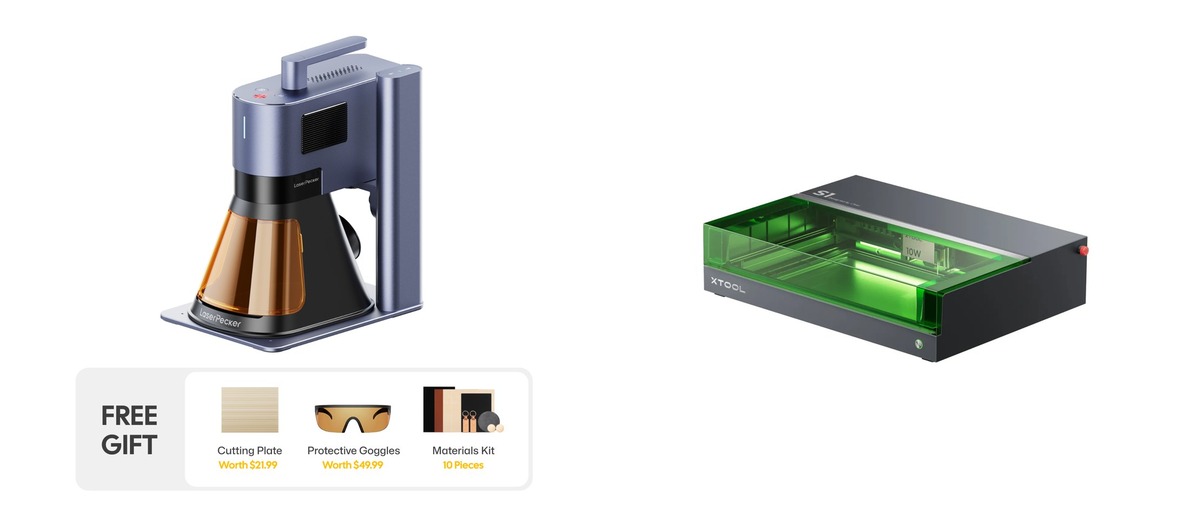
Ask what your five biggest jobs look like
List the five things you most want to make. If most of them are flat sheet stock cut to shape, that is bench work. If most of them are finished objects, awkward shapes, or things belonging to other people, portable stops being a compromise and starts being the only tool that does the job.
What Each Can Do to Materials
Both ranges span diode and fiber, so material capability tracks the laser source rather than the brand.
Diode engraves wood, leather and coated surfaces and cuts thin material. Present in both ranges, from the $749.00 LP2 Plus to the $599.00 M2.
Infrared and fiber mark bare metal and many plastics. LaserPecker covers this from the $1,199.00 LP3; xTool covers it in the F1 Ultra.
CO2 is the gap. Cutting thicker wood and clear acrylic needs a CO2 machine such as the P2S, and that is a bench-only proposition — portability and a CO2 tube do not combine.
Throughput and Repeatability
The aspect where bench machines win decisively, and it is worth being clear why.
A fixed bed means a job can be repeated in the same position all day. Jigs work, batch runs work, and the second hundred pieces are as accurate as the first.
A portable head is set up fresh for each object, which is a feature when every object is different and a real cost when they are all the same.
If you are selling the same product repeatedly, that difference compounds far beyond any price gap.
Where Each One Lives
Portable needs storage, not space
It comes out for a job and goes back in a case, which suits a flat, a shared studio or a stall.
Bench needs a permanent home, plus extraction. Enclosed machines make that manageable indoors, but the footprint is permanent.
For anyone without a dedicated room, that is often the deciding aspect before any specification is compared.
Where Each One Is the Wrong Choice
Wrong to buy portable if the work is repeatable batches of flat stock, or if you want to cut sheet material to shape rather than mark objects.
Wrong to buy bench if the objects are large, fixed, or belong to customers who will not post them to you.
Wrong to buy either for thick wood and clear acrylic without checking the laser type first — that is CO2 work, and most machines in both ranges are not CO2.
Which Should You Choose?

You engrave things that cannot come to you
Portable, without hesitation. Tumblers on a stall, guitars, furniture, installed panels — a bench machine simply cannot do this work.
You sell the same product repeatedly
Bench. Fixed positioning and jigs are worth more than portability the moment you make the same thing twice.
You want to cut, not just mark
Bench, and check the laser type. Cutting thicker stock and clear acrylic means CO2.
You genuinely need both
Common, and worth saying: many makers end up with a bench machine for production and something small for on-site work. Buy the one that unblocks the work you already have.
You are still deciding
Start with what LaserPecker is, then the wider comparison in the best laser engravers for beginners.
Conclusion
At the overlap point these two sell nearly the same laser hardware for exactly the same money, which is the clearest possible sign that the specification is not the decision.
The decision is whether the work comes to you. If it does, buy the bed and the enclosure. If it does not, buy the machine that travels.
And if the honest answer is thicker wood and clear acrylic, neither class is the answer — that is CO2 work on a bench.
Whichever machine you end up with, the design side is the same problem: getting artwork that a laser can actually follow. Atomm AI generates craft-ready artwork, and the community projects are free to open and adapt on any brand of machine.
Frequently Asked Questions about LaserPecker and xTool
Is LaserPecker as good as xTool?
They are different classes of tool rather than better or worse. LaserPecker machines are portable and work on objects that cannot fit on a bed. xTool machines are bench tools with a defined work area, an enclosure and repeatable positioning.
Which is better for engraving tumblers and finished objects?
Portable, in most cases. A LaserPecker sets up next to the object, so awkward shapes and items too large for a bed stop being a problem. That is the job this class of tool exists for.
Which is better for a small business?
A bench machine, if you sell the same product repeatedly, because fixed positioning and jigs make batch work accurate. A portable machine suits on-site personalisation, markets and one-off customer items.
Can a LaserPecker cut wood?
The diode models cut thin material, in the same way any diode does. Thicker stock and clear acrylic need a CO2 laser, which is a bench-only category — portability and a CO2 tube do not combine.
Do both mark bare metal?
Yes, at the right models. LaserPecker covers it from the LP3 at $1,199 with an infrared source, and xTool covers it with the fiber in the F1 Ultra. Bare metal always needs fiber or infrared, never a plain diode.
Which should I buy first?
The one that unblocks work you already have. Many makers end up with both — a bench machine for production and something small for on-site jobs — but buying for a hypothetical second use case is how people end up with the wrong first machine.
Design something to engrave
Free Atomm generators export ready artwork for any laser, portable or bench.
