
People use “jigsaw” and “puzzle” as if they mean the same thing. They do not. A puzzle is the whole category of problems designed to be solved; a jigsaw is one specific type within it.
This guide explains what each word actually means, why the two get mixed up, the main puzzle types you will run into, and how to tell which one someone is talking about.
Turn a photo into a jigsaw puzzlePick the piece count, difficulty, and cut shape, then export a ready-to-cut file free.Try the generatorKey Takeaways
- A puzzle is any problem or game built to be solved — crosswords, riddles, Rubik's Cubes, and jigsaws all count.
- A jigsaw puzzle is one specific type: an image cut into interlocking pieces that you reassemble.
- So every jigsaw is a puzzle, but most puzzles are not jigsaws — the words are not interchangeable.
What Is a Puzzle?
A puzzle is any problem, game, or toy designed to test ingenuity. The defining trait is that it has a goal and a solution, and getting there requires reasoning, pattern recognition, or dexterity rather than luck.
That makes “puzzle” an umbrella term. It covers word puzzles like crosswords, logic puzzles like sudoku, mechanical puzzles like a Rubik's Cube, and physical assembly puzzles like jigsaws.

Because the category is so broad, saying “I bought a puzzle” genuinely is ambiguous. It could mean a 1,000-piece landscape or a pocket-sized metal brainteaser.
What Is a Jigsaw?
A jigsaw puzzle is a picture printed on a rigid sheet and cut into small interlocking pieces. You solve it by fitting every piece back into its correct position to rebuild the original image.

The name comes from the tool, not the game. Early versions in the 1760s were maps glued to wood and cut apart by hand, and the saw used for that fine curved cutting was called a jigsaw.
Modern jigsaws are usually die-cut cardboard, though wooden ones are still made — and laser cutting has largely replaced the original hand-sawing for custom pieces.
Jigsaw vs. Puzzle: The Difference
The relationship is one of category and member:
| Puzzle | Jigsaw Puzzle | |
|---|---|---|
| What it is | The whole category of solvable problems | One specific type within that category |
| Format | Words, numbers, logic, mechanical, or physical | Always an image cut into interlocking pieces |
| How you solve it | Varies — reasoning, spelling, rotation, dexterity | Fit every piece back into position |
| Examples | Crossword, sudoku, riddle, Rubik's Cube, jigsaw | 500-piece landscape, photo puzzle, wooden puzzle |
In short: every jigsaw is a puzzle, but most puzzles are not jigsaws. Calling a crossword a “jigsaw” is wrong; calling a jigsaw a “puzzle” is correct but vague.
One regional note worth knowing: in British English, “jigsaw” on its own almost always means the puzzle. In American English it more often means the power tool, so the full phrase “jigsaw puzzle” is preferred.
The Main Types of Puzzles

- Jigsaw puzzles — an image cut into interlocking pieces, reassembled by shape and picture.
- Word puzzles — crosswords, word searches, and anagrams, solved with vocabulary.
- Logic and number puzzles — sudoku, nonograms, and grid logic problems.
- Mechanical puzzles — Rubik's Cubes, metal disentanglement puzzles, and burr puzzles.
- 3D puzzles — models and structures assembled from flat interlocking parts.
Only the first and last are physically assembled from cut pieces, which is why those two are the ones makers actually produce at home.
Jigsaws and Other Puzzles in Practice
Five community pieces that show where the line actually falls. The first three are jigsaws by any definition; the last two are puzzles that are not quite jigsaws.
1. Blank jigsaw puzzle for customization

A blank jigsaw board cut as nothing but the interlocking grid. Strip away the artwork and this is the definition of a jigsaw: tabs and blanks that hold neighbouring pieces together mechanically. Anything without that interlock is a different kind of puzzle.
Get this design →2. Square Jigsaw Puzzle Featuring Engraved Portrait of a Couple
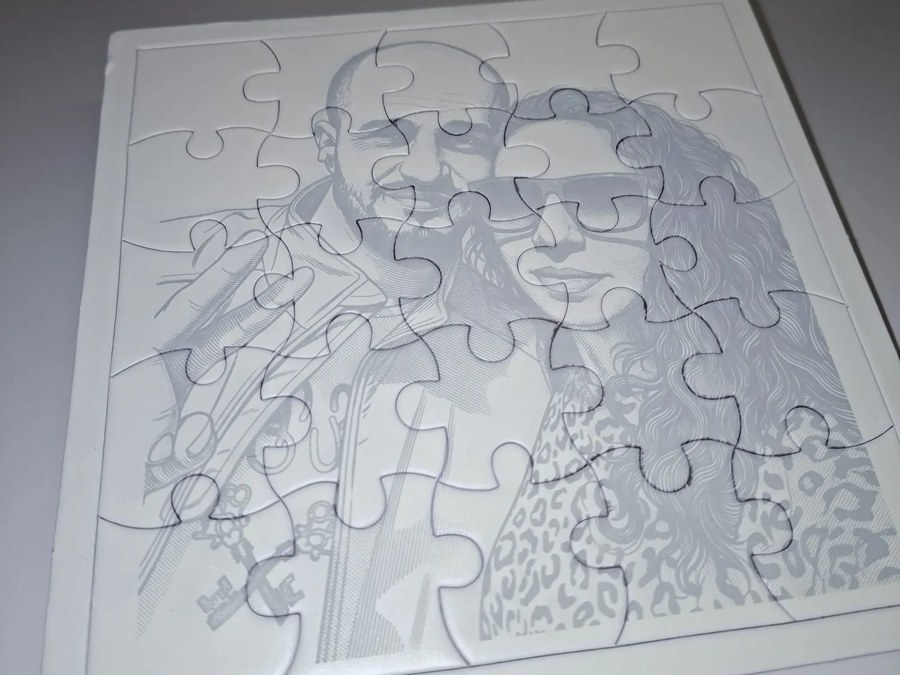
A portrait engraved across a square jigsaw. The image is what makes it solvable, which is the other half of the jigsaw idea: pieces are matched by picture as well as by shape, and a blank board would be far harder.
Get this design →3. Pig Wooden Jigsaw Puzzle Plan Laser Cutting
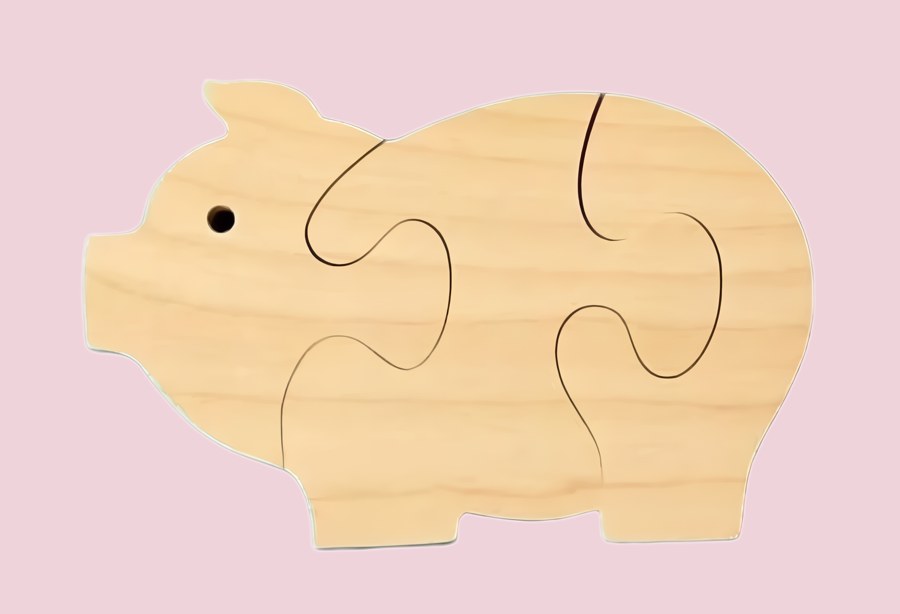
A pig in five chunky interlocking pieces. Still a jigsaw — the pieces lock — but the cut lines follow the animal's anatomy rather than a grid, which is how the format adapts to a two-year-old.
Get this design →4. Flower jigsaw Puzzle
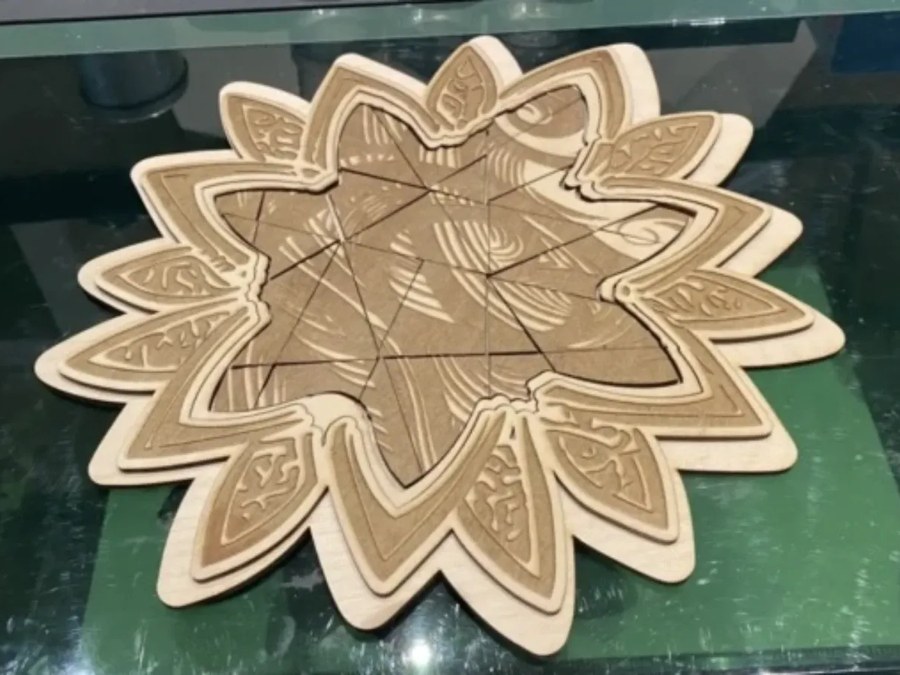
A layered flower where the petals form the boundaries instead of tabs. Most people would call this a puzzle and almost nobody would call it a jigsaw, which is exactly where the distinction lives: no interlock, so pieces sit rather than hold.
Get this design →5. Puzzle Automne - Laser Cut Wooden Autumn Fox Leaf Jigsaw Puzzle

An autumn scene cut inside a maple-leaf outline. The pieces interlock, so it qualifies, but the shaped border breaks the rectangle people expect from the word jigsaw — a reminder that the shape was never part of the definition.
Get this design →Why the Two Words Get Confused
Jigsaws dominate the shelf. When a shop sells “puzzles” for adults, the majority are jigsaws, so shoppers learn the general word while only ever seeing one specific type.
The tool name adds a second layer. Because a jigsaw is also a woodworking saw, “jigsaw” alone can point at either a power tool or a boxed puzzle, depending on who is speaking and where.
If you need to be unambiguous, say jigsaw puzzle for the pieces-and-picture kind and name the specific type — crossword, sudoku, cube — for anything else.
How Jigsaw Puzzles Are Made
Commercially, an image is printed and laminated onto board, then pressed through a steel die that stamps out the interlocking shapes in one hit. The die is expensive, which is why mass-market puzzles reuse the same cut patterns.
For one-off or custom puzzles, laser cutting is the practical route: the cut pattern is a file rather than a physical die, so every puzzle can have a different image, piece count, and shape at no extra tooling cost.
That is what makes personalized puzzles viable at a quantity of one. If you want to try it, our guide on making laser-cut wooden puzzles from scratch covers the full process.
For design inspiration, we also collect custom puzzle designs and ideas for turning a photo into a personalized jigsaw.
How to Make Your Own Jigsaw Puzzle
Making one is mostly a file problem rather than a woodworking problem. Four steps, and the generator handles the part that looks hardest.
Step 1: Pick the artwork and the finished size
Decide the physical dimensions before anything else, in millimetres. Piece size is simply that size divided by the piece count, and it is what decides whether the result is fiddly.

Step 2: Generate the jigsaw grid
Set the size and piece count in the puzzle generator and check the preview. Watch where cut lines fall — a line through the middle of a face is worth nudging the grid to avoid.
Step 3: Choose how the image gets onto the material
Engrave it directly for a permanent monochrome result, or print it and mount it on plywood before cutting if you need full colour.
Step 4: Cut through both layers
Three-millimetre plywood is the usual choice: thick enough that tabs survive being handled, thin enough to cut in one pass.

Piece count is a difficulty dial, not a quality mark
Five to fourteen pieces for toddlers, twenty to fifty for young children, one hundred to two hundred for a casual adult. High counts only work if the artwork has detail everywhere — a large flat sky becomes interchangeable pieces.
For the full walkthrough, including shaped outlines and choosing a print-on-demand service, see how to make your own puzzle. Working from a photograph? Making a puzzle from a photo covers picture selection and resolution.
Conclusion
A jigsaw is one kind of puzzle: interlocking pieces that reassemble into a picture. Puzzle is the umbrella term, covering crosswords, sudoku, mechanical puzzles, and much else.
In everyday British English “jigsaw” usually means the boxed picture puzzle outright, while American English says “puzzle” for the same object. Neither is wrong, which is why the confusion persists.
If you are making rather than naming one, the distinction stops mattering the moment you open a generator — what matters is finished size, piece count, and whether the artwork is engraved or printed.
Frequently Asked Questions about Jigsaws and Puzzles
Is a jigsaw the same as a puzzle?
Not exactly. A jigsaw is one type of puzzle. “Puzzle” is the broad category that also includes crosswords, sudoku, riddles, and mechanical puzzles like a Rubik's Cube.
Why is it called a jigsaw puzzle?
It is named after the saw used to make the first ones in the 1760s. Maps were glued to wood and cut into pieces with a fine curved-cutting saw known as a jigsaw, and the name stuck to the puzzle.
Is a Rubik's Cube a jigsaw?
No. It is a mechanical puzzle, solved by rotating layers rather than assembling cut pieces. It qualifies as a puzzle but has none of the defining traits of a jigsaw.
What is the difference between a jigsaw and a jigsaw puzzle?
In American English, “jigsaw” alone usually means the power saw, so the puzzle is called a jigsaw puzzle. In British English, “jigsaw” on its own is commonly understood as the puzzle.
Are 3D puzzles jigsaws?
Sometimes. If a 3D puzzle is built from flat interlocking pieces cut from a sheet, it is closely related. Models assembled from moulded parts or blocks are generally classed separately.
Make a puzzle from your own photo
Pick a piece count and cut style, preview it, and export a ready-to-cut file for free.
