
The yin yang is the black-and-white circle split by an S-curve, each half holding a dot of the other. It is a Chinese philosophical symbol for how opposites depend on each other rather than fight each other.
This guide covers what yin and yang actually mean, what every part of the symbol stands for, its correct name, real pieces built from it, and why the design works so well as a cut or engraved object.
Browse yin yang designsFree downloadable yin yang cut files and engraving designs from the Atomm community.See the designsKey Takeaways
- Yin is the receptive, dark, cool principle; yang is the active, bright, warm one. Neither is good or bad.
- The symbol's proper name is the taijitu. “Yin yang” names the concept, not the drawing.
- The small dots are the whole point: each side contains the seed of its opposite, so nothing is ever purely one thing.
What Does Yin Yang Mean?
Yin and yang describe complementary forces in Chinese philosophy. Yin is associated with dark, cold, stillness, and the receptive; yang with light, warmth, movement, and the active.

The central claim is relational: neither exists alone. There is no shadow without light, no rest without activity. Each is defined by the other, and the balance between them shifts continuously.
This differs sharply from a good-versus-evil framing. Yin is not the bad half; it is the necessary counterpart. Health, in this view, comes from balance rather than from one side winning.
What Each Part of the Symbol Shows
Every element carries meaning, which is why versions drawn from memory usually get something wrong.
| Element | Represents |
|---|---|
| The circle | The whole — everything, complete and self-contained |
| The S-curve | A fluid boundary; the two sides flow into each other rather than being split |
| Black half (yin) | Dark, cool, still, receptive, night |
| White half (yang) | Bright, warm, active, assertive, day |
| The two dots | Each side carries the seed of its opposite — nothing is ever pure |
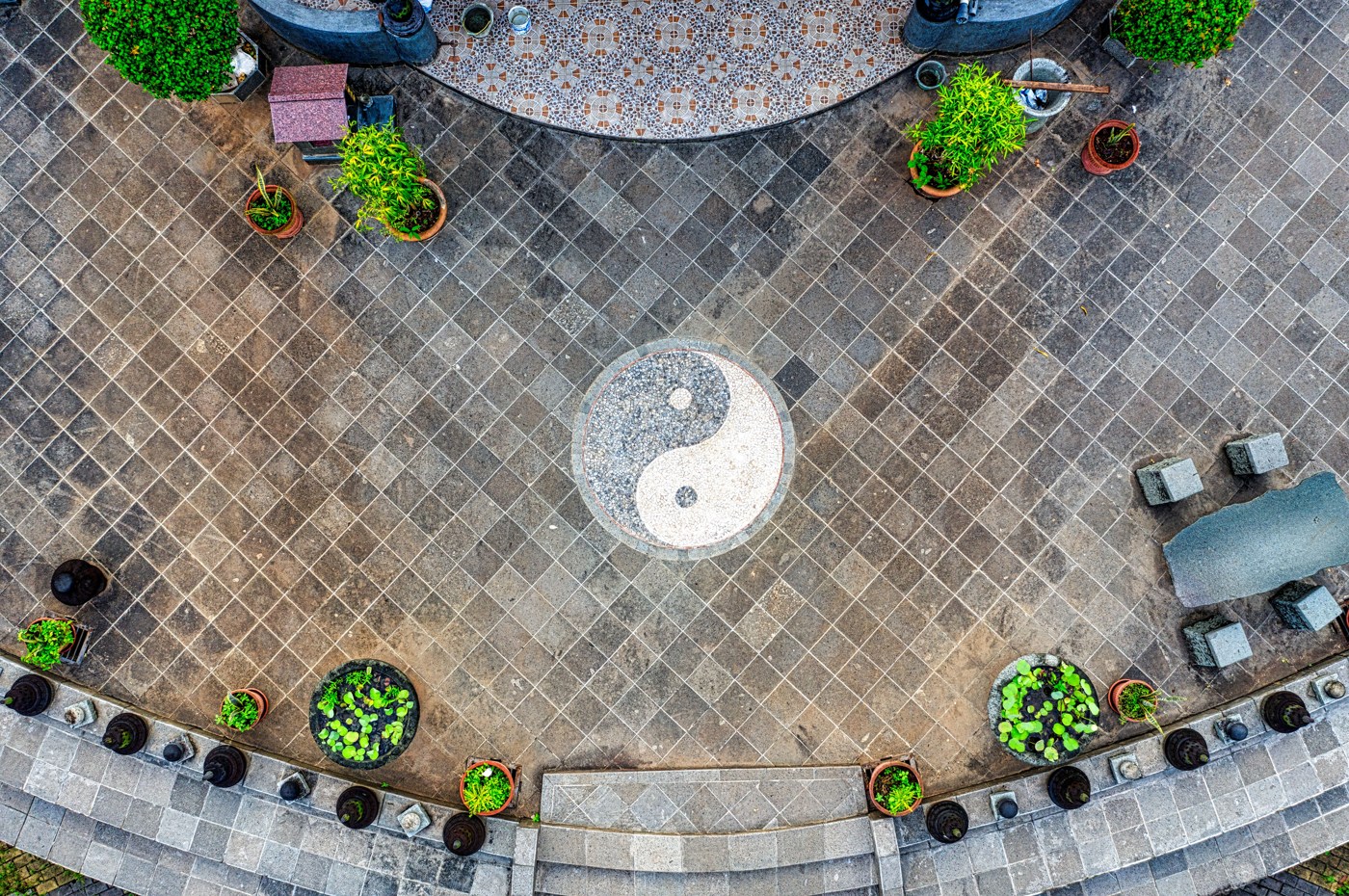
The dots are what people most often leave out when drawing it from memory, and they carry the core idea. A circle split by a plain curve would say opposites are separate; the dots say each contains the other.
The curve matters too. A straight line would suggest a fixed division, while the S implies motion — one side growing as the other recedes, the way day turns into night.
Taijitu: The Symbol's Real Name
The diagram is properly called the taijitu, meaning “diagram of the supreme ultimate”. Yin and yang are the concepts; the taijitu is the picture that expresses them.
The ideas are ancient, appearing in Chinese thought well over two thousand years ago, and are foundational to Taoism, traditional Chinese medicine, feng shui, and martial arts.
The familiar circular form is considerably more recent than the philosophy, having been standardised by Song dynasty scholars. Older texts describe the concepts without this particular drawing.
Getting the proportions right
The S-curve is built from two circles, each with half the diameter of the outer circle, meeting at the centre. Freehand versions almost always make one half larger than the other, which quietly contradicts the meaning.
Good Yin Yang Designs and Patterns
Five pieces from the Atomm community showing how far the symbol stretches — from a strict reading to playful variants. Each is a downloadable design.
1. Yin Yang Koi Clock

A wall clock where two koi form the halves, their eyes landing where the dots belong. Clocks suit this symbol unusually well: the face is already a circle, and the hands moving through it echo the idea of one state continuously turning into the other.
Get this design →2. Intricate mandala design with Yin Yang symbol

A layered mandala with a yin yang at its centre. The surrounding pattern is dense and highly symmetrical, which makes the plain two-tone circle in the middle read as a resting point. A useful lesson in contrast: complexity needs somewhere quiet to sit next to.
Get this design →3. Yin Yang Acrylic Earrings

Acrylic drop earrings in the plain two-tone form. Because acrylic comes in solid sheet colours, the two halves can be genuinely different materials rather than one engraved surface, which is the cleanest way to get true contrast at this size.
Get this design →4. Round Slate Coaster with Yin Yang Paw and Heart Design

A slate coaster where the two halves are a paw print and a heart. It breaks the traditional form deliberately, and it still reads instantly, which shows how much recognition the outer circle and S-curve carry on their own.
Get this design →5. Yin Yang key ring inlay

A key ring made as an inlay, with one half cut from a contrasting wood and fitted into the other. Inlay solves the problem the dots create: instead of small circles falling out as loose pieces, they become inserts held by the surrounding material.
Get this design →Why It Works So Well as Cut Art
The taijitu is close to a perfect design for making. It is two flat shapes, one closed outline, and no shading — exactly what a cutting machine wants.
Contrast is built in. Cut the yang half from light wood and the yin half from dark, or cut one half away entirely and let the backing show through, and the symbol reads instantly.

The one detail to watch is the dots. Cut them right through and the small circles fall out as loose pieces, so either engrave them, inlay them in the contrasting material, or leave a bridge.

Because the shape is geometric rather than traced from a photo, it draws cleanly in any vector editor — and if you start from an image instead, our walkthrough on converting an image to SVG covers the tracing step.
Conclusion
The yin yang says that opposites need each other. The drawing encodes that claim precisely — a circle for the whole, an S-curve for a boundary that moves, and two dots insisting that neither side is ever pure.
For making, it is one of the friendliest designs there is: flat, two-tone, and geometrically constructible. Get the two half-circles right, decide early how the dots survive, and the rest follows.
If the construction interests you more than the philosophy, geometric design covers the same rule-based approach applied more broadly, and Zen design shares the restraint.
Frequently Asked Questions about Yin Yang
What does the yin yang symbol mean?
That opposites are interdependent. Dark and light, still and active, each define the other and flow into one another, with neither able to exist on its own.
Which side is yin and which is yang?
Yin is the dark half — cool, still, receptive. Yang is the light half — warm, active, assertive. Neither is positive or negative in a moral sense.
What do the two dots mean?
That each side contains the seed of its opposite. Nothing is ever purely yin or purely yang, which is why leaving the dots out changes the meaning of the symbol.
Is the yin yang symbol religious?
It comes from Chinese philosophy and is central to Taoism, but it functions more as a philosophical diagram than a devotional image, and is widely used outside any religious context.
What is the symbol actually called?
The taijitu, meaning diagram of the supreme ultimate. Yin and yang are the two principles it depicts; the taijitu is the diagram itself.
How do I stop the dots falling out when cutting?
Engrave them instead of cutting through, inlay them as inserts in a contrasting material, or leave a small bridge holding each dot to the surrounding shape.
Find a yin yang design to make
Browse free yin yang cut files and engraving designs from the community.
