




























![[Laser cut and engrave] Laser Cut Wooden Nine Men's Morris Board Game Set](https://storage-us.atomm.com/resource/xtool/community/attachment/xtool-community/826b4741-28a2-49ce-8f37-cf86d39f2fa6.JPG?x-oss-process=image/resize,w_1200,h_900,limit_0/interlace,1/format,webp/auto-orient,1)
![[Laser cut and engrave] Laser Cut Wooden Nine Men's Morris Board Game Set](data:image/png;base64,iVBORw0KGgoAAAANSUhEUgAAAAoAAAAKCAYAAACNMs+9AAAAAXNSR0IArs4c6QAAABdJREFUKFNjZCASMBKpjmFUId6QIjp4AAppAAuXjCs4AAAAAElFTkSuQmCC)
![[Laser cut and engrave] Laser Cut Wooden Nine Men's Morris Board Game Set](https://storage-us.atomm.com/resource/xtool/community/attachment/xtool-community/826b4741-28a2-49ce-8f37-cf86d39f2fa6.JPG?x-oss-process=image/resize,w_200,h_150,limit_0/interlace,1/format,webp/auto-orient,1)
![[Laser cut and engrave] Laser Cut Wooden Nine Men's Morris Board Game Set](https://storage-us.atomm.com/resource/xtool/community/attachment/xtool-community/3579d267-410c-4ae1-87e6-65c8505c2750.JPG?x-oss-process=image/resize,w_200,h_150,limit_0/interlace,1/format,webp/auto-orient,1)
![[Laser cut and engrave] Laser Cut Wooden Nine Men's Morris Board Game Set](https://storage-us.atomm.com/resource/xtool/community/attachment/xtool-community/2e3ae0d3-c439-4b54-b693-129743c0d1a7.JPG?x-oss-process=image/resize,w_200,h_150,limit_0/interlace,1/format,webp/auto-orient,1)
Jeu du Moulin
 Instruction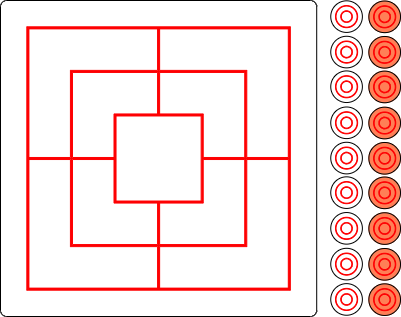


Information
Jeu de société le Moulin
Instruction
Step1: Découpe


Gravez et préparez le plateau de jeu et la première face des pions.
Step2: Pions


Retournez les pions pour les imprimer sur la deuxième face.
Pour cette opération, supprimer la fonction “couper”.
Step3: Règle du jeu

But du Jeu : Bloquer son adversaire ou ne lui laisser que 2 pions
Le jeu se déroule sur les 24 points du tableau (les 12 coins des carrés et les 12 intersections qu’ils forment avec les lignes perpendiculaires).
Le but est de parvenir à ce que le joueur adverse ait seulement deux pions sur le tableau ou qu’il lui soit impossible de réaliser des mouvements, ses pièces étant bloquées. Pour ceci, le but immédiat est d’essayer de faire des Moulins (trois pions en ligne) avec ses propres pions, ce qui donne le droit de capturer un pion de l’opposant.
Le jeu a deux phases bien différenciées.
Le jeu débute par une phase de placement des pions, puis est suivie par la phase de déplacements.
1ère Phase:
Le jeu commence avec le tableau vide.
À la première phase les joueurs placent tour à tour leurs neuf pions sur un point libre quelconque du tableau. Pendant cette phase il est interdit de déplacer les pions déjà placés su le tableau.
2ème Phase:
Une fois les pions placés, on commencera la deuxième phase.
Chaque joueur à son tour déplace une de ses pièces sur un point adjacent (à côté) libre, à travers la ligne qui relie le point d’origine et le point de destination.
Pendant les deux phases du jeu, si le pion incorporé ou déplacé termine un « moulin », c’est-à-dire une rangée de trois pions de la même couleur situées sur les trois points d’une même ligne, il sort du jeu un pion ennemi. A moins qu’il ne reste plus de pions à sortir, un joueur ne peut toucher aucun pion qui fasse partie d’un moulin ennemi. Une fois sorti du jeu, un pion ne peut plus y rentrer. Dès qu’un joueur n’a plus que trois pions sur le tableau, il peut déplacer ses pions librement sur n’importe quel point du plateau (la règle des points adjacents ne vaut plus).
Fin du Jeu
Un joueur gagne la partie dans l’un des deux cas suivants :
Un des joueurs a réalisé 7 prises et par conséquent son adversaire a seulement deux pions et ne peut plus former de moulins.
Un des joueurs ne peut plus réaliser de mouvement parce que tous ses pions sont bloqués.
La partie est nulle quand il y a égalité quand aucun des 2 joueurs n’arrive à gagner.